Altitude measurement

The altitude of a star above the horizon is measured with a sextant. The name comes from the shape of the instrument. It is one sixth of a circle.
The previous text may have given the impression that measuring a star’s altitude above the horizon is straightforward. Unfortunately, it is not. You must account for a number of errors that affect the measurement result.
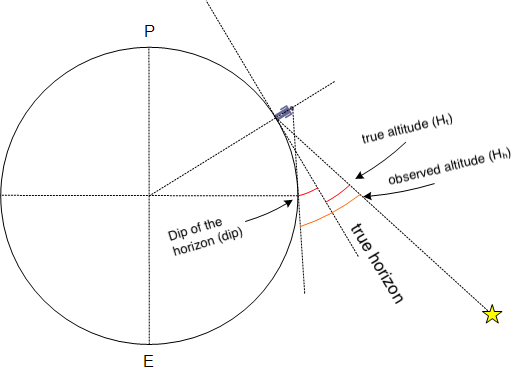
From the sextant you read the celestial body’s measured altitude or sextant altitude (Hi). To obtain the true altitude (Ht) used throughout the preceding text, several correction factors must be applied.
Index correction (ic) arises from errors in the sextant. Its mirrors may not be perfectly parallel. The index error can be measured using the sextant itself. If it is less than 5’, it can be neglected. The index correction changes, for example, with temperature, so it should ideally be checked with every measurement if high accuracy is required.
When the measured altitude (Hi) is corrected with the index correction (ic), we obtain the observed altitude (Hh).
Dip correction (dip) depends on your height above the Earth’s surface. The higher you are, the farther you can see over the curvature of the Earth, and the lower the visible horizon appears.
When the observed altitude (Hh) is corrected for dip, we obtain the apparent altitude (Ha).
The Earth’s atmosphere is denser near the surface and thinner at higher altitudes. Because of this, light rays entering at an angle bend toward the surface. Due to refraction (R), you can see the Sun even after it has geometrically set below the true horizon.
When the apparent altitude (Ha) is corrected for refraction (R), we obtain the local altitude (HP).
The Sun and Moon are close enough to Earth that we cannot assume their direction is the same when observed from different points on Earth. Stars, however, are so distant that their direction can be assumed identical from anywhere on Earth. For the Moon and Sun, parallax (P) must be taken into account.
When the local altitude (HP) is corrected for parallax (P), we obtain the true limb altitude (Ht’).
Stars are so far away that they can always be treated as point sources of light. They have no apparent size. The Sun and Moon, however, appear as disks in the sky. When measuring their altitude, you always measure either the upper or lower limb. A correction equal to the celestial body’s semidiameter must therefore be added or subtracted to obtain the true center altitude (Ht).
When the true limb altitude (Ht’) is corrected for the celestial body’s semidiameter (SD), we obtain the true center altitude (Ht).
The altitude obtained from tables or calculation is the computed altitude (Hl).
 With the exception of index correction, all the corrections above are taken from the Nautical Almanac. In practice, you must first look up the dip correction from one table, and then from another table the correction depending on apparent altitude, which combines corrections due to refraction, parallax, and semidiameter.
C o n t e n t s
- Position fixing from the stars
- The starry sky
- The celestial sphere
- What you see at the North Pole as the Earth rotates
- How the starry sky changes when traveling to the equator
- Effect of Earth’s rotation on the starry sky at the equator
- Celestial meridian, upper and lower culmination
- Change in star altitude at the poles, equator, and between them
- Declination
- Example of determining latitude
- Hour angle, Greenwich Hour Angle (GHA)
- Aries, the celestial Greenwich
- Sidereal Hour Angle (SHA)
- Local Hour Angle (LHA)
- Relation between hour angle and time
- Example of determining longitude and latitude from the Sun at noon
- Relation between angles, degrees, and nautical miles on Earth
- Position circle
- Azimuth (A)
- True bearing to a star
- Nautical triangle
- Solving the nautical triangle (altitude calculation)
- Position fixing using Marcq Saint Hilaire intercept method
- Star identification
- Details and practice
- Time
- Time difference (ΔT)
- Altitude measurement
- Example of position fixing
- Twilight
- Calculation of twilight time
- Navigation exam
Hamburg VII 2026