Position circle
When you are directly under a star, its altitude above the horizon is 90°. You are then directly at the star’s projection point on Earth. As you move away from the projection point, the star appears lower in the sky. This is due to the curvature of the Earth. Remember what happened when you walked from the North Pole to the equator.
A position circle is a circle on the surface of the Earth where, from every point on the circle, a given star appears at the same altitude above the horizon. The center of the circle is the star’s projection point.
If you move closer to the projection point, the star appears higher in the sky. If you move further away, it appears lower.
The horizon plane and the line from the Earth’s center through your position to the zenith are perpendicular to each other.
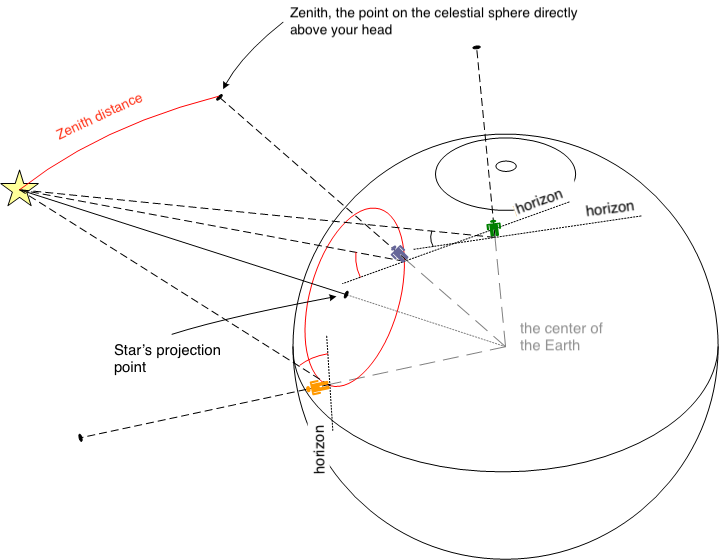
Because the star is extremely far away compared to the size of the Earth, the line from the star’s projection point to the star and the line from any point on Earth to the star are practically parallel.
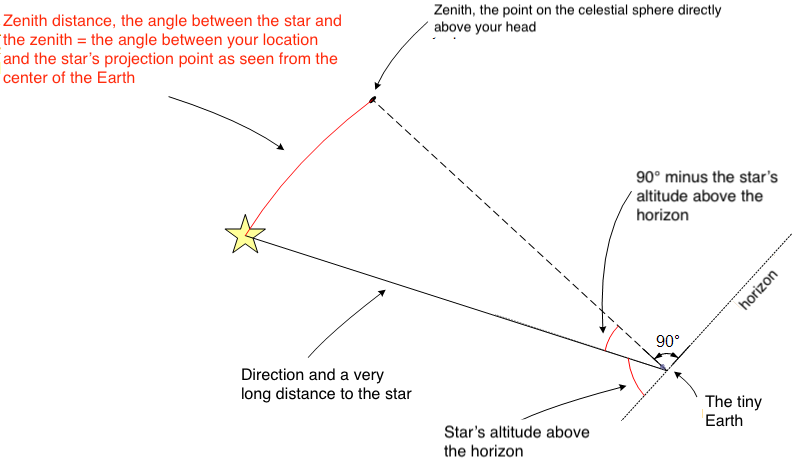
In reality, the situation is closer to the diagram below. From this image you can see that when you measure the angle between the horizon and the star, the angle between the star and your zenith—called the zenith distance—is 90° minus the star’s altitude above the horizon.
zenith distance = 90° − star altitude above the horizon
The zenith distance is also the angle between your position and the star’s projection point as seen from the center of the Earth.
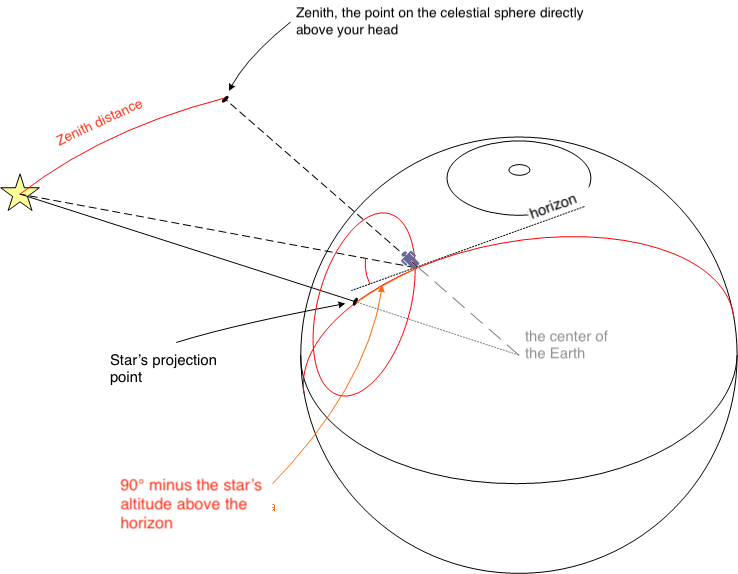
If you draw a great circle on the Earth passing through your position and the star’s projection point, the distance along this line is the shortest distance between your position and the projection point. See what was previously written about great circles in the chapter Relationship between angles, degrees and nautical miles on the Earth's surface.
Degrees and their subdivisions (minutes) also express the distance in nautical miles between your position and the star’s projection point. One degree contains 60 arcminutes. Your distance to the star’s projection point is equal to 60 × the zenith distance in degrees.
Example: If you measure the star’s altitude above the horizon to be 40.4°, the zenith distance is 90° − 40.4° = 49.6°. Your distance to the star’s projection point is then 49.6 × 60 = 2976 nautical miles.
C o n t e n t s
- Determining position from stars
- The night sky
- The celestial sphere
- What you see at the North Pole as the Earth rotates
- How the night sky changes when you travel to the equator
- The effect of Earth’s rotation on the sky at the equator
- The celestial meridian, upper culmination and lower culmination
- Changes in star altitude at the North Pole, equator and in between
- Declination
- Example of determining latitude
- Hour angle, Greenwich Hour Angle (GHA)
- Aries, Greenwich of the celestial sphere
- Sidereal hour angle (SHA)
- Local hour angle (LHA)
- Relationship between time and hour angle
- Example of determining longitude and latitude from the Sun at noon
- Relationship between angles, degrees and nautical miles on the Earth's surface
- Position circle
- Azimuth
- True bearing to a star
- Nautical triangle
- Solving the nautical triangle (altitude calculation)
- Position fixing from stars using the Marcq Saint Hilaire intercept method
- Star identification
- Details and practice
- Time
- Time difference (ΔT)
- Altitude measurement
- Example of position fixing
- Twilight
- Calculating twilight time
- Navigation association exam
Hamburg VII 2026