Changes in Star Altitude at the North Pole, the Equator, and Between Them
At the North Pole, all stars remain at the same altitude above the horizon, and as the Earth rotates they appear to circle around you once every 24 hours.
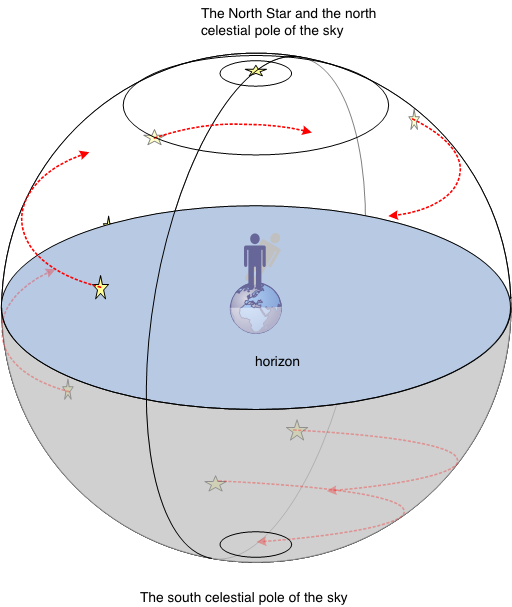
Seen from below looking upward, it looks like this.
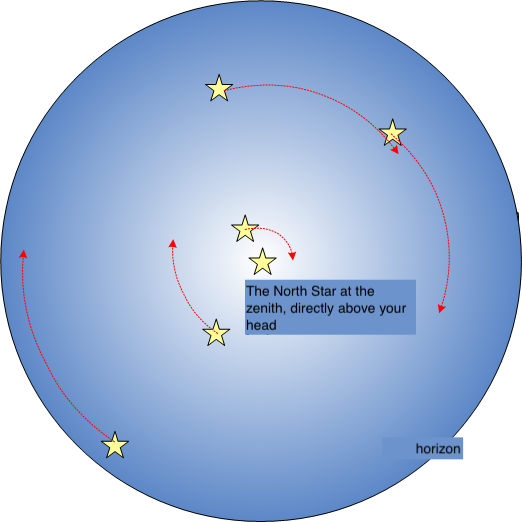
As the Earth rotates, the stars move around the celestial North Pole. Polaris appears almost stationary because it is very close to the celestial pole. The stars do not rise or set; they remain continuously at the same altitude above the horizon.
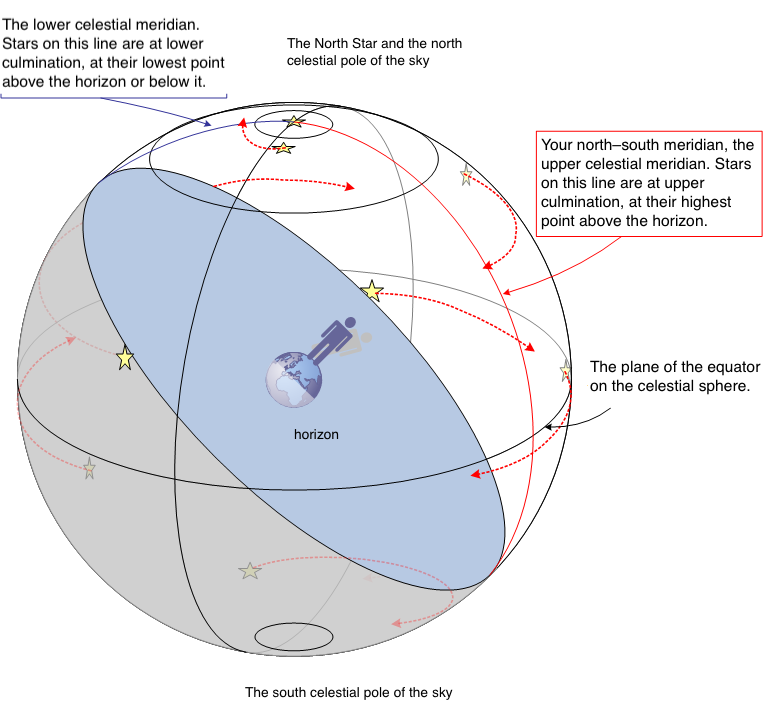
When you move to somewhere between the North Pole and the equator, the apparent motion of the stars caused by Earth’s rotation looks different to an observer on the ground. Polaris remains fixed in the north, at 60° above the horizon in Helsinki, and the other stars rotate around it. Depending on the length of the night—which in turn depends on the season—it varies whether stars that rise in the east in the evening have time to set in the west before the Sun rises. In winter they often do, and we can observe a large part of the celestial sphere during the night.
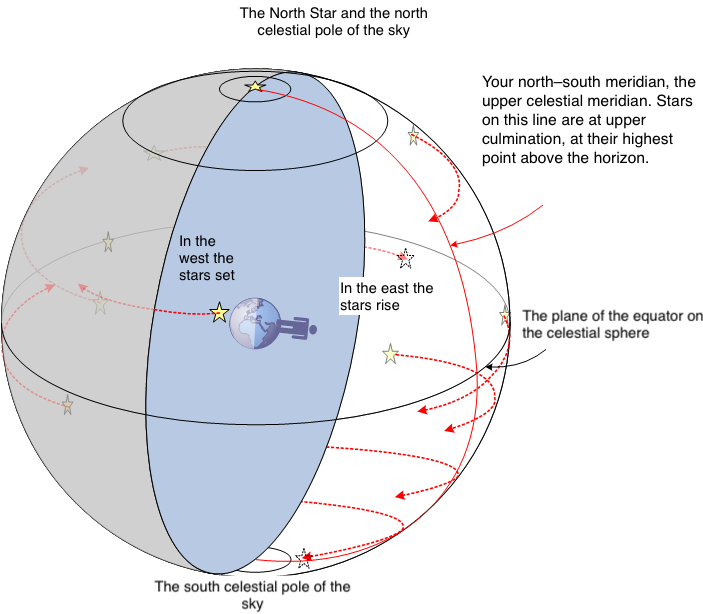
Near the North Pole, stars do not set below the horizon. They rise south of the pole to higher altitudes and, as they circle to the northern side of the pole, they descend again toward the horizon, reaching their lower culmination directly in the north on the lower meridian.
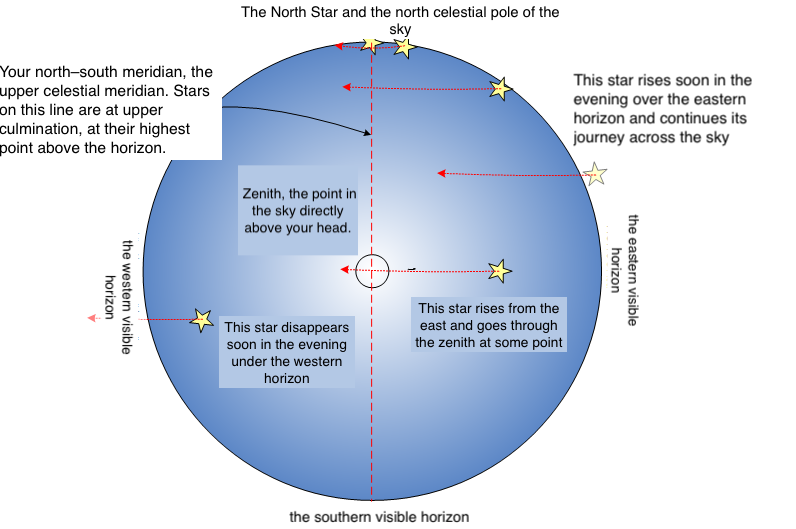
Seen from below, the situation in Finland looks roughly like this.
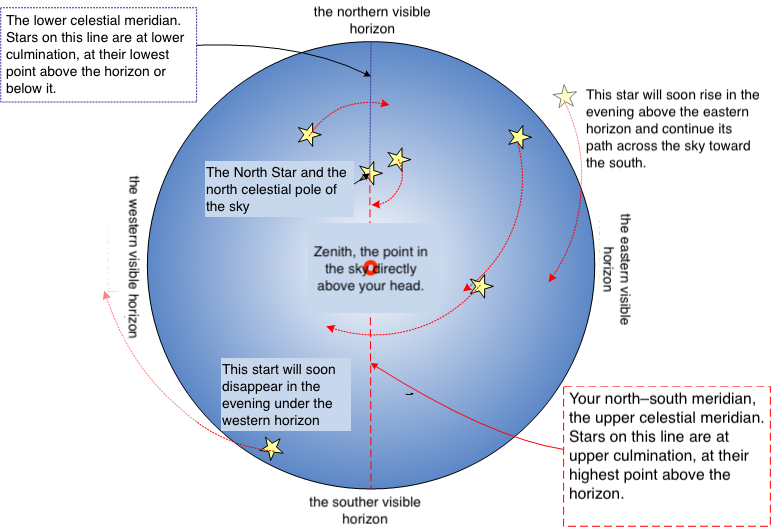
Stars north of Polaris move from the west toward the east, circling around Polaris. When they are on your meridian—that is, on the north–south line across the sky—they are at their upper culmination and at their highest altitude above the horizon.
Stars south of Polaris rise from the east toward their upper culmination and eventually set in the west.
All of this apparent motion is due to the rotation of the Earth beneath you. In reality, the stars remain fixed; it is you who are moving with the rotating Earth.
At the equator, the apparent motion of the stars is different from the previous examples. At the equator, the celestial north pole and celestial south pole lie on the horizon. The lower part of the celestial meridian is entirely below the horizon. All stars rise from the eastern horizon toward the upper meridian and set in the west.
C o n t e n t s
- Celestial Navigation
- The Starry Sky
- The Celestial Sphere
- What You See from the North Pole as the Earth Rotates
- How the Starry Sky Changes When You Travel to the Equator
- The Effect of Earth’s Rotation on the Starry Sky at the Equator
- The Celestial Meridian, Upper Culmination, and Lower Culmination
- Changes in Star Altitude at the North Pole, the Equator, and Between Them
- Declination
- Example of Determining Latitude
- Hour Angle, Greenwich Hour Angle (GHA)
- Aries, the Greenwich of the Celestial Sphere
- Sidereal Hour Angle (SHA)
- Local Hour Angle (LHA)
- The Relationship Between Hour Angle and Time
- Example of Determining Longitude and Latitude from the Sun at Noon
- The Relationship Between Angles, Degrees, and Nautical Miles on Earth’s Surface
- Circle of Equal Altitude
- Azimuth (A, Azimuth)
- True Bearing to a Star
- The Navigational Triangle
- Solving the Navigational Triangle, or Sight Reduction
- Celestial Navigation Using Marcq Saint Hilaire’s “Intercept” Method
- Star Identification
- Details and Practice
- Time
- Time Difference (ΔT)
- Altitude Measurement
- Example of Position Fixing
- Twilight
- Calculating Twilight Time
- Navigation Association Examination
Hamburg VII 2026