How the Starry Sky Changes When You Travel to the Equator
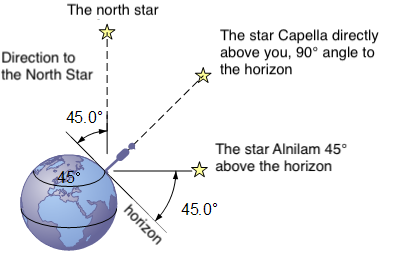
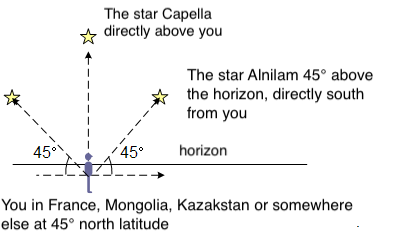
Imagine that you have superpowers and are able to stop the Earth's rotation at the moment when Alnilam and Capella are directly in front of you. Pack some food into your backpack and start walking toward the equator. During your journey toward the equator, the Earth's gravity constantly pulls you toward the Earth's center, and your orientation in space changes. When you reach latitude 45°, the positions of the stars you see have changed. Capella is now directly above you, and Alnilam is no longer on the horizon but has risen above it. If you measured the angle between the horizon and Alnilam, you would notice that it is exactly 45°. Likewise, behind you Polaris has descended toward the horizon. It is no longer above your head but behind you, also 45° above the horizon.
The zenith is the point on the celestial sphere directly above your head. When you were at the North Pole, Polaris was directly above you, at the zenith. Now Capella is above you, at the zenith. Regardless of where you are, if you see Capella directly above you, Polaris 45° above the horizon, and Alnilam 45° above the horizon, you can be certain that you are at latitude 45°. In fact, seeing only Capella or Polaris in this position would already be enough for you to conclude that you are on the 45th parallel. In this situation you cannot rely on Alnilam alone, because you cannot be sure in which direction you are seeing it. More about that later.
From the positions of these stars you still cannot determine anything about longitude. That depends on how the Earth is positioned beneath your feet — at which point you happened to stop it when you began your journey toward Alnilam. Because you are traveling southward from the North Pole on an Earth whose rotation has been stopped, you are moving along some meridian of longitude. Right now we do not know, or even care, whether you are heading toward the equator via Paris, New York, or Beijing.
Continue your journey toward the equator. It is already becoming warmer, and you can leave the fur coat behind.
When you arrive at the equator, the situation looks like this.
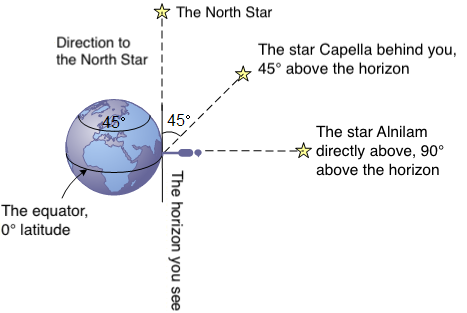
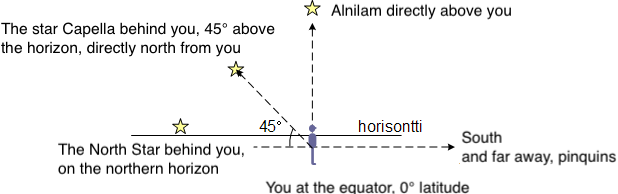
By now you are hopefully beginning to understand how latitude can be determined. In this example the task has been simplified by stopping the Earth's rotation and placing the stars along a straight north–south line. They are said to be in upper culmination. At that moment their altitude above the horizon is at its maximum.
Another good term to remember is zenith. It refers to the point in the sky directly above your head. When you were at the North Pole, Polaris was at the zenith, directly above your head. When you were at latitude 45°, Capella was at the zenith. As you walked toward the equator, Alnilam rose higher and higher above the horizon until, at the equator, it was directly above your head at the zenith.
C o n t e n t s
- Celestial Navigation
- The Starry Sky
- The Celestial Sphere
- What You See from the North Pole as the Earth Rotates
- How the Starry Sky Changes When You Travel to the Equator
- The Effect of Earth’s Rotation on the Starry Sky at the Equator
- The Celestial Meridian, Upper Culmination, and Lower Culmination
- Changes in Star Altitude at the North Pole, the Equator, and Between Them
- Declination
- Example of Determining Latitude
- Hour Angle, Greenwich Hour Angle (GHA)
- Aries, the Greenwich of the Celestial Sphere
- Sidereal Hour Angle (SHA)
- Local Hour Angle (LHA)
- The Relationship Between Hour Angle and Time
- Example of Determining Longitude and Latitude from the Sun at Noon
- The Relationship Between Angles, Degrees, and Nautical Miles on Earth’s Surface
- Circle of Equal Altitude
- Azimuth (A, Azimuth)
- True Bearing to a Star
- The Navigational Triangle
- Solving the Navigational Triangle, or Sight Reduction
- Celestial Navigation Using Marcq Saint Hilaire’s “Intercept” Method
- Star Identification
- Details and Practice
- Time
- Time Difference (ΔT)
- Altitude Measurement
- Example of Position Fixing
- Twilight
- Calculating Twilight Time
- Navigation Association Examination
Hamburg VII 2026