Local Hour Angle (LHA)
First, remind yourself what the celestial meridian is.
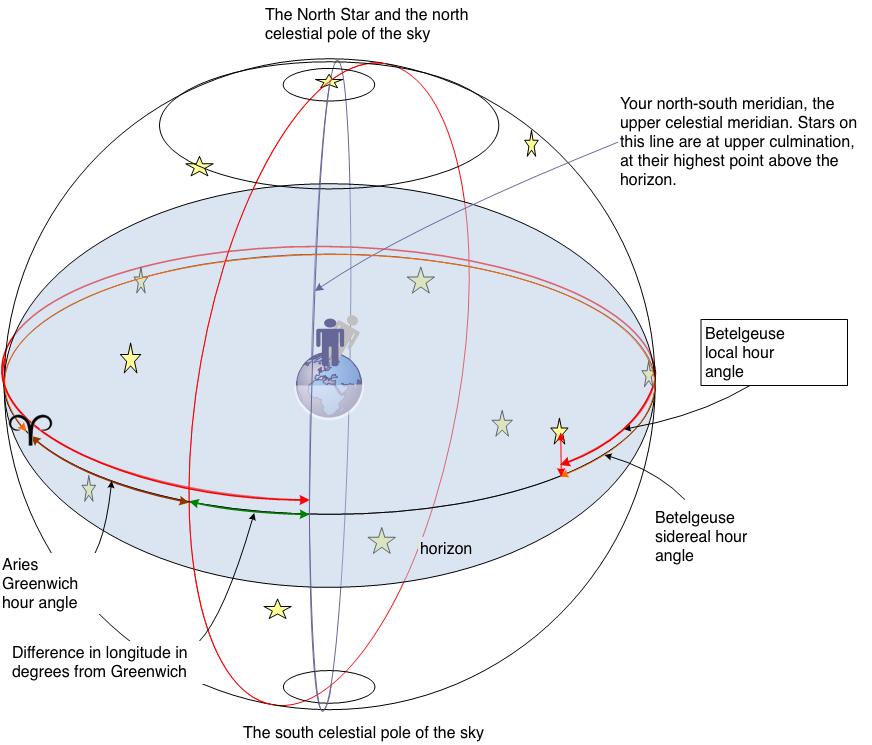
The local hour angle (LHA), local hour angle, starts from the celestial object's upper culmination point, meaning the moment when it is on the celestial meridian. When a star is on the western horizon, its local hour angle is 90°.
When a star is on the eastern horizon, rising from below the horizon, its local hour angle is 270°.
The local hour angle can be calculated from the Greenwich Hour Angle (GHA) if the local longitude is known.
LHA = GHA + local longitude, where west longitude is negative and east longitude is positive. If the result is greater than 360°, 360° is subtracted.
For example, if you are in Helsinki, your longitude is approximately 24° 56’ east. You observe the star Betelgeuse. Its sidereal hour angle is 201° 11’. The Greenwich Hour Angle of Aries at the observation time is 70°20’. What is the local hour angle of Betelgeuse?
First, we calculate Betelgeuse’s Greenwich Hour Angle.
Betelgeuse’s Greenwich Hour Angle is:
|
Aries Greenwich Hour Angle ( |
Betelgeuse sidereal hour angle (SHA) |
Betelgeuse Greenwich Hour Angle (GHA) |
||
| 70° 20’ | + | 201° 11’ | = | 271° 31’ |
 GHA)
GHA)
Since Helsinki is at east longitude, it is added to the Greenwich Hour Angle.
|
Betelgeuse Greenwich Hour Angle (GHA) |
Helsinki longitude, 24° 56’ east of Greenwich |
Betelgeuse local hour angle (LHA) |
||
| 271° 31’ | + | 24° 56’ | = | 296° 27’ |
C o n t e n t s
- Position fixing using stars
- The night sky
- The celestial sphere
- What you see at the North Pole as the Earth rotates
- How the night sky changes when you travel to the equator
- Effect of Earth's rotation on the sky at the equator
- Celestial meridian, upper and lower culmination
- Change in star altitude at the poles, equator, and in between
- Declination
- Example of determining latitude
- Hour angle, Greenwich Hour Angle (GHA)
- Aries, Greenwich of the celestial sphere
- Sidereal hour angle (SHA)
- Local hour angle (LHA)
- Relationship between hour angle and time
- Example of determining longitude and latitude from the Sun at noon
- Relationship between angles, degrees, and nautical miles on Earth
- Spherical triangle of position
- Azimuth
- True bearing to a star
- Nautical triangle
- Solving the nautical triangle (altitude calculation)
- Position fixing using the Marcq Saint Hilaire intercept method
- Star identification
- Details and practice
- Time
- Time difference (ΔT)
- Altitude measurement
- Example of position fixing
- Twilight
- Calculating twilight time
- Navigation Association exam
Hamburg VII 2026