Time
In the first grade at school we learn to read time from a clock. After that we are expected to know where we should be at each hour. At sea, it works the other way around: the clock tells us where we are. Because of this, we need to be much more precise with time than usual. A one-second error can mean a position error of 0.25 nautical miles, or 2.5 cables, or about 460 meters.
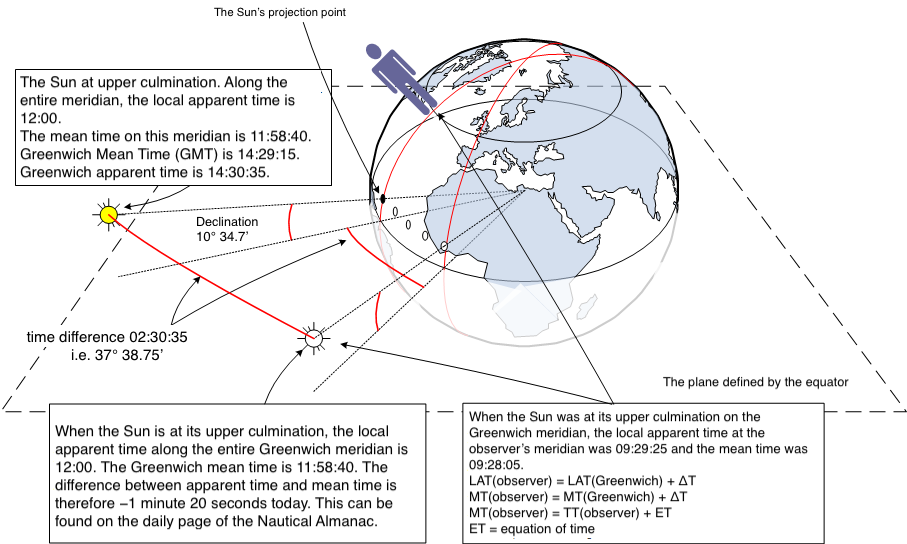
The apparent time of a location, Local Apparent Time (LAT), tells how long it has been since the Sun passed the location’s lower meridian. Therefore, when the apparent time at a location is 12:00, the Sun is at the upper culmination point. The length of the apparent solar day varies, as described in the chapter Example of determining longitude and latitude from the Sun at noon. A sundial shows local apparent time unless it is continuously adjusted.
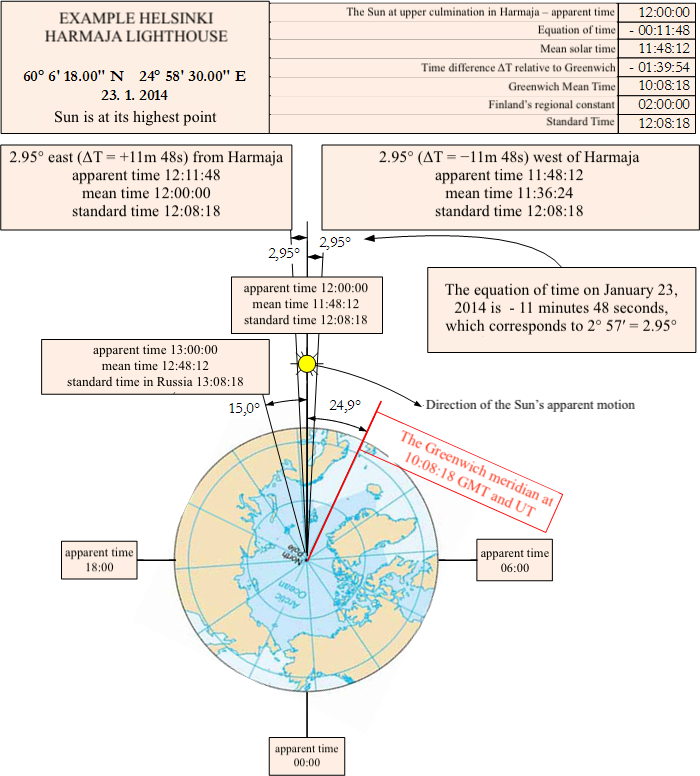
It would be impractical if the length of the day were constantly changing. For this reason, mean time (MT) is used. A mean time day is always exactly 24 hours long. The difference between mean time and apparent time is called the equation of time, Equation of Time (ET). The relationship is always MT = LAT + ET. The values of the equation of time for each day can be found in the Nautical Almanac, as well as the mean times when the Sun crosses the Greenwich upper meridian and lower meridian.
Below are other time-related terms that will be discussed next.
Apparent Time, Local Apparent Time (LAT) – the time elapsed since the Sun passed the local lower meridian.
Mean Time, Mean Time (MT) – assumes all days are 24 hours long. The difference between mean time and apparent time is the equation of time.
Equation of Time, Equation of Time (ET) – the difference between apparent time and mean time. MT = LAT + ET.
Note that time zones are not used in apparent time and mean time. Even a meter or a few centimeters east or west of you corresponds to a different apparent or mean time than on your own longitude.
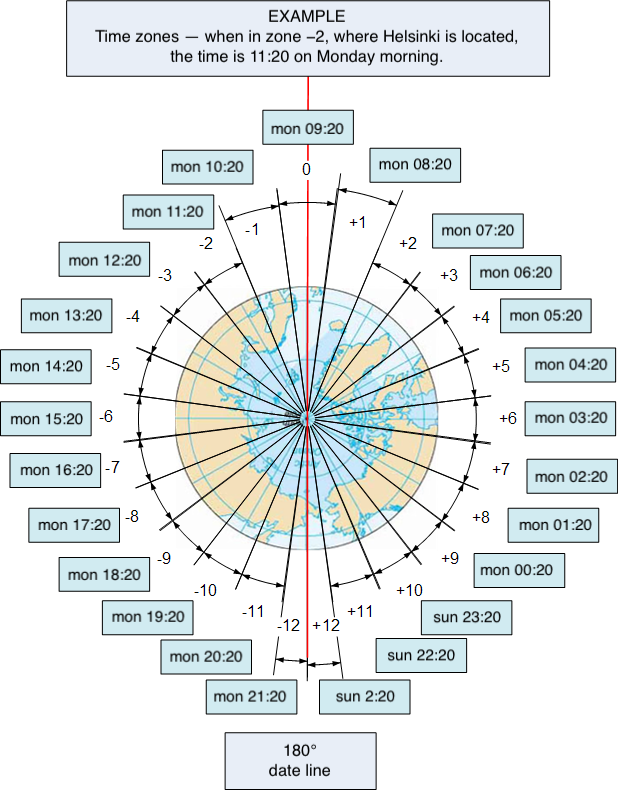
Zone Time, Zone Time (ZT) – the time used within a 15° wide zone determined by the current longitude at sea. There are 25 zones. The central meridian of the zero zone (Z) is the 0° meridian, which passes through Greenwich. The boundaries of the zero zone are 7.5° east and 7.5° west longitude. East of the zero zone there are 12 zones, and west of it another 12 zones. In the east, the first zone is ZT(-1), followed by ZT(-2), ZT(-3), and so on. In the west the zones are ZT(+1), ZT(+2), ZT(+3) ... ZT(+12). Between ZT(+12) and ZT(-12) lies the International Date Line.
Universal Time, Universal Time (UT) – the time in the zero zone.
Zone constant, zone constant (zc) – the correction added to zone time to obtain universal time. UT = ZT + zc. The zone constant for a given longitude is obtained by dividing the longitude by 15 and rounding to the nearest integer. For example, Helsinki is at approximately 24.56° east longitude. 24.56 / 15 = 1.64. Rounded gives 2. Since Helsinki is east of Greenwich, the zone constant is negative, so it is -2.
Standard Time, Standard Time (ST) – the official time used in a country, i.e. the local legal time. Standard time does not account for daylight saving time, so in Finland clocks show standard time only in winter.
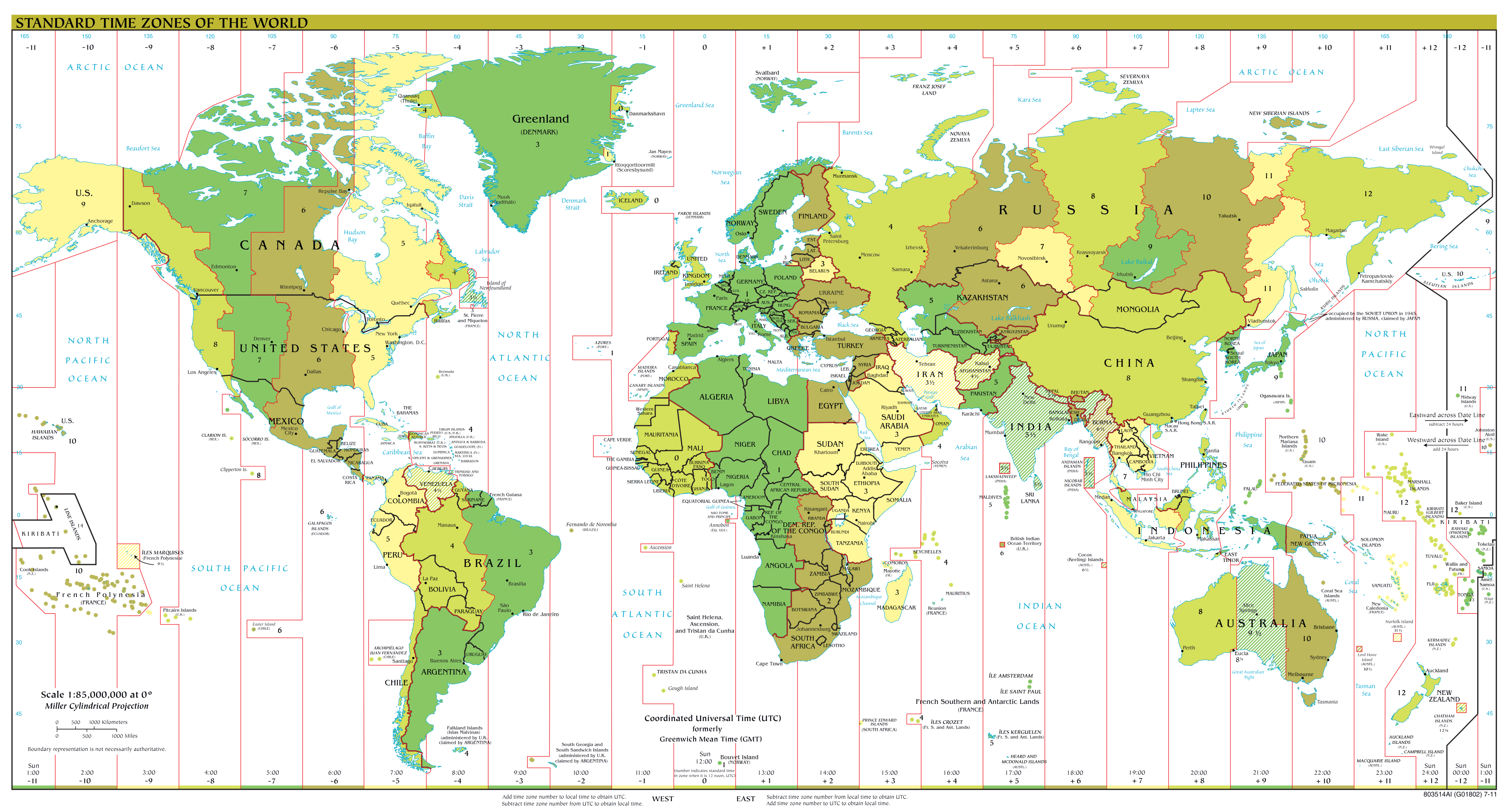
When standard time (ST) is adjusted by the zone constant (sc), universal time (UT) is obtained: UT = ST + sc.
Legal Time, Legal Time (LT) – the official national time, which includes possible daylight saving time.
Chronometer Time (KrT), Chronometer Time (CT) – as shown in the chapter Example of determining longitude and latitude from the Sun at noon, a ship’s clock (chronometer) is used for position fixing. A one-second error corresponds to a 463-meter position error at the equator and about 230 meters in Helsinki. Chronometer time is the time shown by the ship’s chronometer, i.e. Greenwich time or universal time. At the Greenwich meridian (0° longitude), UT = GMT = standard time in England.
Chronometer rate (knt) – indicates how much the chronometer gains or loses over time. This correction is added to the chronometer reading to obtain correct chronometer time.
Chronometer correction (krk) – the correction added to the chronometer reading to obtain universal time. It is positive if the chronometer is slow and negative if it is fast. If the daily rate is known, the current correction can be found by adding the rate to the previous day's correction.
Greenwich Mean Time, Greenwich Mean Time (GMT) – mean time at Greenwich.
C o n t e n t s
- Position fixing from stars
- The night sky
- The celestial sphere
- What you see at the North Pole as Earth rotates
- How the night sky changes when you travel to the equator
- Effect of Earth's rotation on the sky at the equator
- Celestial meridian, upper and lower culmination
- Change in star altitude at pole, equator and between
- Declination
- Example of determining latitude
- Hour angle, Greenwich Hour Angle (GHA)
- Aries, celestial Greenwich
- Sidereal Hour Angle (SHA)
- Local Hour Angle (LHA)
- Relationship between time and hour angle
- Example of longitude and latitude from the Sun at noon
- Angles, degrees and nautical miles on Earth
- Position circle
- Azimuth (A)
- True bearing to a star
- Nautical triangle
- Solving the nautical triangle (sight reduction)
- Position fixing using Marcq Saint-Hilaire intercept method
- Star identification
- Details and practice
- Time
- Time difference (ΔT)
- Altitude measurement
- Example of position fixing
- Twilight
- Calculating twilight time
- Navigation exam
Hamburg VII 2026