The Celestial Meridian, Upper Culmination, and Lower Culmination
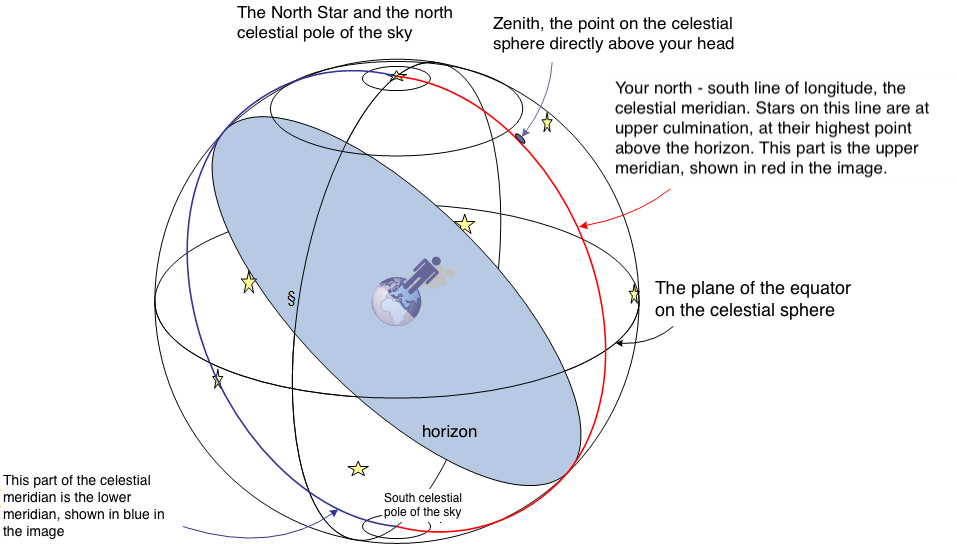
The line that runs across the sky through the celestial north pole, the celestial south pole, and your zenith, and all the way around the celestial sphere, is called the celestial meridian. The celestial poles divide it into two parts. The part corresponding to your longitude is the upper meridian. The other part of the celestial meridian lies on the opposite side of the celestial sphere. This is the lower meridian. Stars that are on the celestial meridian and on its upper meridian part are also at their upper culmination, meaning they are at their highest point above the horizon. Celestial bodies that are on the lower meridian are at their lower culmination. Note that when you are close enough to the Earth's poles, or when observing stars near the poles, you can see the same celestial body both at its upper and lower culmination. The clearest example is the summer Sun in the Arctic, which north of the Arctic Circle does not set below the horizon during midsummer. At its lowest point it is at lower culmination on the lower meridian, and at midday it is at its highest point on the upper meridian.
C o n t e n t s
- Celestial Navigation
- The Starry Sky
- The Celestial Sphere
- What You See from the North Pole as the Earth Rotates
- How the Starry Sky Changes When You Travel to the Equator
- The Effect of Earth’s Rotation on the Starry Sky at the Equator
- The Celestial Meridian, Upper Culmination, and Lower Culmination
- Changes in Star Altitude at the North Pole, the Equator, and Between Them
- Declination
- Example of Determining Latitude
- Hour Angle, Greenwich Hour Angle (GHA)
- Aries, the Greenwich of the Celestial Sphere
- Sidereal Hour Angle (SHA)
- Local Hour Angle (LHA)
- The Relationship Between Hour Angle and Time
- Example of Determining Longitude and Latitude from the Sun at Noon
- The Relationship Between Angles, Degrees, and Nautical Miles on Earth’s Surface
- Circle of Equal Altitude
- Azimuth (A, Azimuth)
- True Bearing to a Star
- The Navigational Triangle
- Solving the Navigational Triangle, or Sight Reduction
- Celestial Navigation Using Marcq Saint Hilaire’s “Intercept” Method
- Star Identification
- Details and Practice
- Time
- Time Difference (ΔT)
- Altitude Measurement
- Example of Position Fixing
- Twilight
- Calculating Twilight Time
- Navigation Association Examination
Hamburg VII 2026