The Celestial Sphere
It is precisely because of the vastness of space and the apparent fixed positions of the stars that they can be used for navigation. Viewed from Proxima Centauri or its neighbor Alpha Centauri, the Earth's orbit around the Sun is an insignificant wobble. In practice, you can think of the stars as fixed in space and us on Earth at the center among them. The Earth's motion around the Sun is so small that it is not worth taking into account. The stars do move relative to each other, of course, but so slowly that during a human lifetime they appear not to move anywhere.
The starry sky appears to change for only two reasons.
- The Earth rotates around its axis
- During different seasons we see different parts of the starry sky at night
You can imagine the starry sky as a huge sphere surrounding the Earth, with the stars attached to its inner surface. This is actually how the Babylonians imagined the world. We are on Earth at the center of an empty sphere. The stars are attached to the inside surface of a larger empty sphere. As the Earth rotates at the center of this empty sphere, we see different parts of the inside of the celestial sphere.
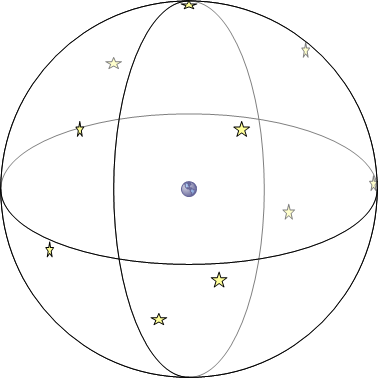
On the surface of the Earth, you can always see only half of the celestial sphere. The Earth beneath your feet blocks the other half.
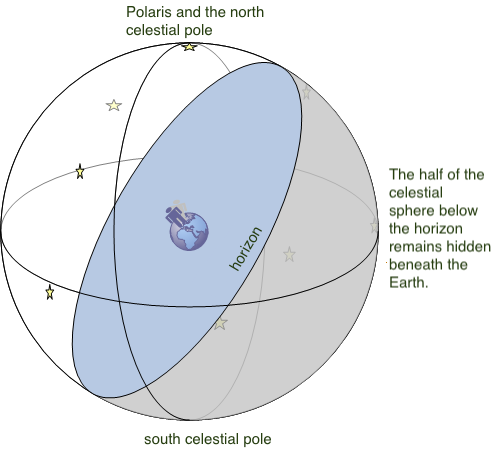
As the Earth rotates, you see different parts of the celestial sphere.
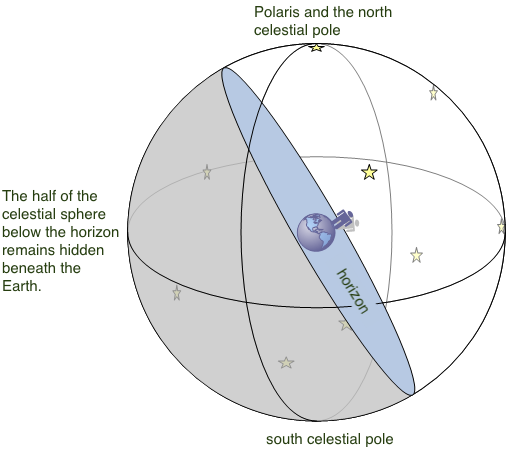
This is naturally true only if it were night all the time, or if you were using a telescope or binoculars. The brightest stars can also be seen during the day, or at least during dawn and dusk, with a telescope.
Which side of the Earth the Sun illuminates depends on the season. More about that later. In the following chapters, the Sun will temporarily be ignored. It is assumed that you can see the stars whether it is day or night.
C o n t e n t s
- Celestial Navigation
- The Starry Sky
- The Celestial Sphere
- What You See from the North Pole as the Earth Rotates
- How the Starry Sky Changes When You Travel to the Equator
- The Effect of Earth’s Rotation on the Starry Sky at the Equator
- The Celestial Meridian, Upper Culmination, and Lower Culmination
- Changes in Star Altitude at the North Pole, the Equator, and Between Them
- Declination
- Example of Determining Latitude
- Hour Angle, Greenwich Hour Angle (GHA)
- Aries, the Greenwich of the Celestial Sphere
- Sidereal Hour Angle (SHA)
- Local Hour Angle (LHA)
- The Relationship Between Hour Angle and Time
- Example of Determining Longitude and Latitude from the Sun at Noon
- The Relationship Between Angles, Degrees, and Nautical Miles on Earth’s Surface
- Circle of Equal Altitude
- Azimuth (A, Azimuth)
- True Bearing to a Star
- The Navigational Triangle
- Solving the Navigational Triangle, or Sight Reduction
- Celestial Navigation Using Marcq Saint Hilaire’s “Intercept” Method
- Star Identification
- Details and Practice
- Time
- Time Difference (ΔT)
- Altitude Measurement
- Example of Position Fixing
- Twilight
- Calculating Twilight Time
- Navigation Association Examination
Hamburg VII 2026