Nautical triangle
We have now gone through all parts of the nautical triangle. A nautical triangle is a triangle on the celestial sphere formed by the zenith, the celestial pole, and a celestial body.
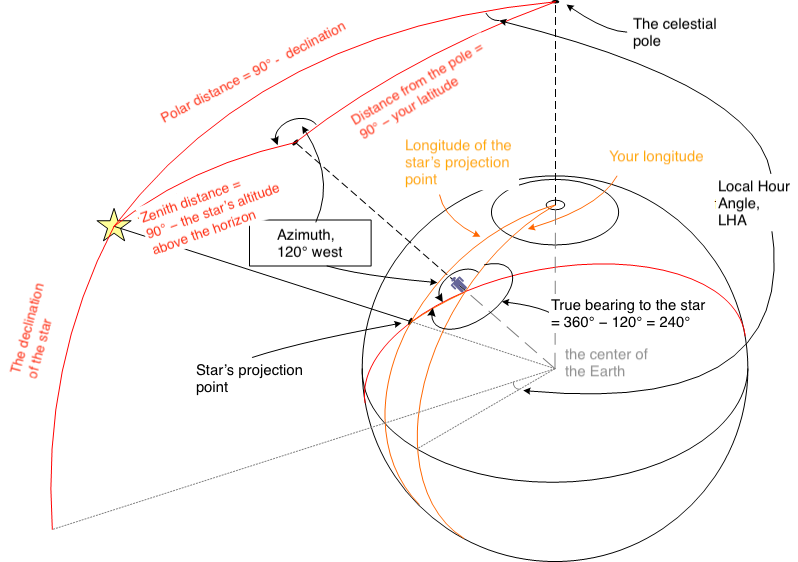
If you know the star’s coordinates, i.e. its declination and local hour angle, and you measure the star’s altitude above the horizon, you can calculate your latitude.
The local hour angle can be calculated if you know the azimuth or true bearing and the star’s declination. See the image above. The azimuth or true bearing tells you the direction of the star’s projection point relative to you. The star’s projection point lies on the great circle that passes through you, and its angular position relative to your longitude is equal to the azimuth. If the declination is 0°, the star’s projection point lies at the intersection of that great circle and the equator. If the declination is greater than 0° and north, the projection point lies north of the equator, at a distance equal to the declination.
Similarly, if you know your latitude, local hour angle (LHA), and the star’s declination, you can calculate its altitude above the horizon as seen from your observation point. Remember that the local hour angle changes continuously as the Earth rotates, by one degree every four minutes.
C o n t e n t s
- Position fixing from the stars
- Night sky
- Celestial sphere
- What you see from the North Pole as the Earth rotates
- How the night sky changes when you travel to the equator
- Effect of Earth’s rotation on the night sky at the equator
- Celestial meridian, upper and lower culmination
- Change in star altitude at the North Pole, equator, and in between
- Declination
- Example of determining latitude
- Hour angle, Greenwich Hour Angle (GHA)
- Aries, Greenwich of the celestial sphere
- Sidereal hour angle (SHA)
- Local hour angle (LHA)
- Relation between hour angle and time
- Example of determining longitude and latitude from the Sun at noon
- Relation between angles, degrees, and nautical miles on Earth
- Position circle
- Azimuth (A, Azimuth)
- True bearing to a star
- Nautical triangle
- Solving the nautical triangle (sight reduction)
- Position fixing from stars using Marcq Saint-Hilaire’s intercept method
- Star identification
- Details and practice
- Time
- Time difference (ΔT)
- Altitude measurement
- Example of position fixing
- Twilight
- Calculating twilight time
- Navigation Association exam
Hamburg VII 2026