Azimuth (A, Azimuth)
The azimuth is the angle, in the Northern Hemisphere, between true north and the direction of a star’s projection point. If the star is to your west, the azimuth is western and the star is setting. If the star is to your east, the azimuth is eastern and the star is rising toward its upper culmination point. At the upper culmination point, the azimuth is either 180° or 0°, depending on whether the star is south or north of you.
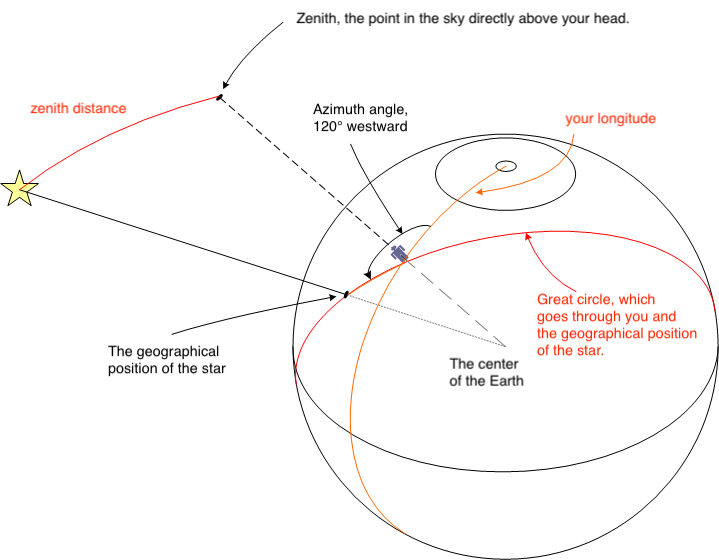
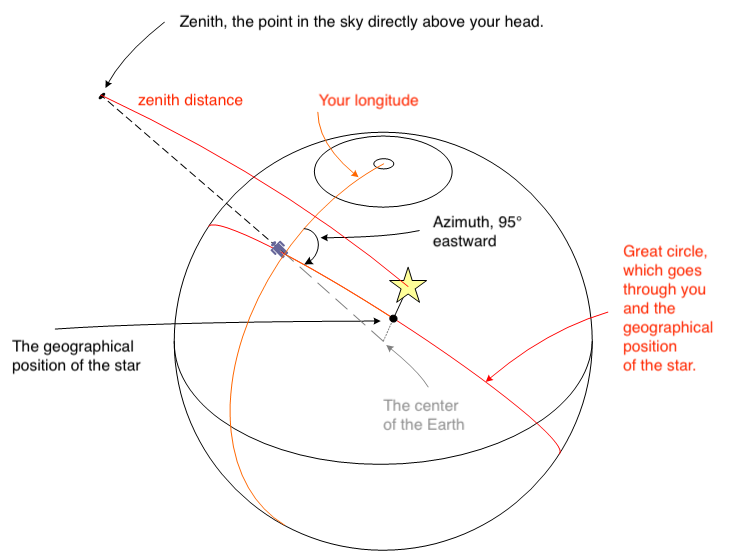
When you are in the Southern Hemisphere, the azimuth is the angle between true south and the direction of the star’s projection point.
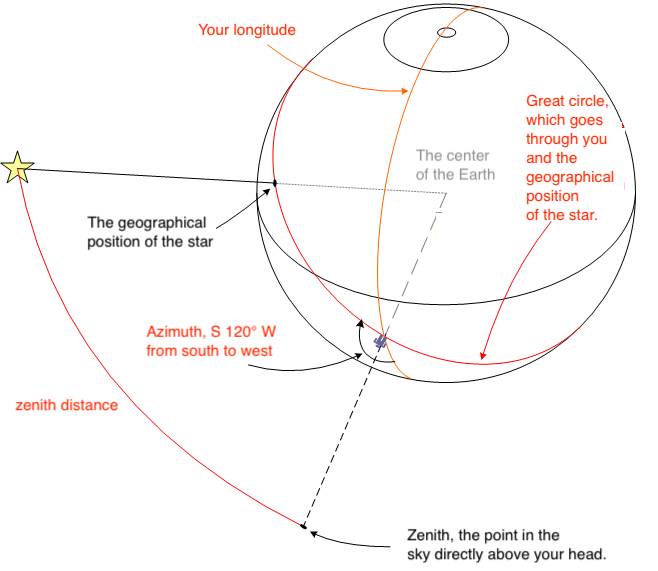
Note that the essential point here is that you are in the Southern Hemisphere. The position of the star’s projection point is not essential.
The direction of the azimuth can be expressed by placing N or S before the angle to indicate whether it is measured from true north (N) or true south (S), and E or W after the value to indicate whether the angle is toward west (W) or east (E). For example, in the image above the azimuth is S 120° W. In the first image of this section it is N 120° W, and in the second N 95° E.
Using azimuth simplifies the creation of navigation tables. The same table values can be used in both the Southern and Northern Hemisphere, and for stars located either west or east of you. This becomes clearer in the section Solving the nautical triangle, i.e. sight reduction.
C o n t e n t s
- Position fixing from the stars
- Night sky
- Celestial sphere
- What you see from the North Pole as the Earth rotates
- How the night sky changes when you travel to the equator
- Effect of Earth’s rotation on the night sky at the equator
- Celestial meridian, upper and lower culmination
- Change in star altitude at the North Pole, equator, and in between
- Declination
- Example of determining latitude
- Hour angle, Greenwich Hour Angle (GHA)
- Aries, Greenwich of the celestial sphere
- Sidereal hour angle (SHA)
- Local hour angle (LHA)
- Relation between hour angle and time
- Example of determining longitude and latitude from the Sun at noon
- Relation between angles, degrees, and nautical miles on Earth
- Position circle
- Atsimuutti (A, Azimuth)
- True bearing to a star
- Nautical triangle
- Solving the nautical triangle (sight reduction)
- Position fixing from stars using Marcq Saint-Hilaire’s intercept method
- Star identification
- Details and practice
- Time
- Time difference (ΔT)
- Altitude measurement
- Example of position fixing
- Twilight
- Calculating twilight time
- Navigation Association exam
Hamburg VII 2026