Declination
Declination is a very important term. A star’s declination tells how high above the horizon the star appears if you are standing at the North Pole looking at it. In that case, Polaris is almost directly above your head. Declination is expressed in degrees, describing the angle between the horizon and the star when you are at the North Pole.
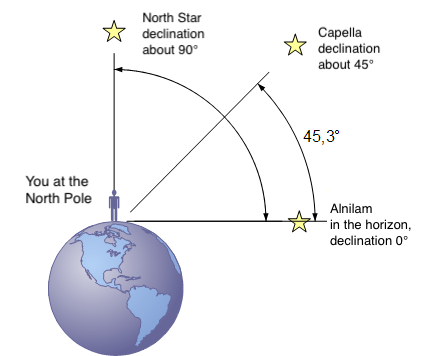
Hopefully you can understand the above based on what was explained earlier. Declination is most often defined in a different way, but the numerical value is the same, and I find the explanation above easier to understand. In other textbooks, declination is described as how far a star is above or below the plane defined by the celestial equator. Since, when standing at the North Pole, you are at a 90° angle to that plane, this is equivalent to describing how high the star appears above your horizon at the North Pole.
When talking about the declination of the Sun and the Moon, their height above the horizon at the North Pole is not exactly the same as their declination, but slightly smaller. The reason is that the Sun and Moon are much closer to Earth than the stars, so it matters whether they are observed from the equator or from the North Pole—the viewing angle is different. More on this later. A star’s declination does not practically change from day to day or even from year to year. Below you can see the declinations (dec) of some stars.
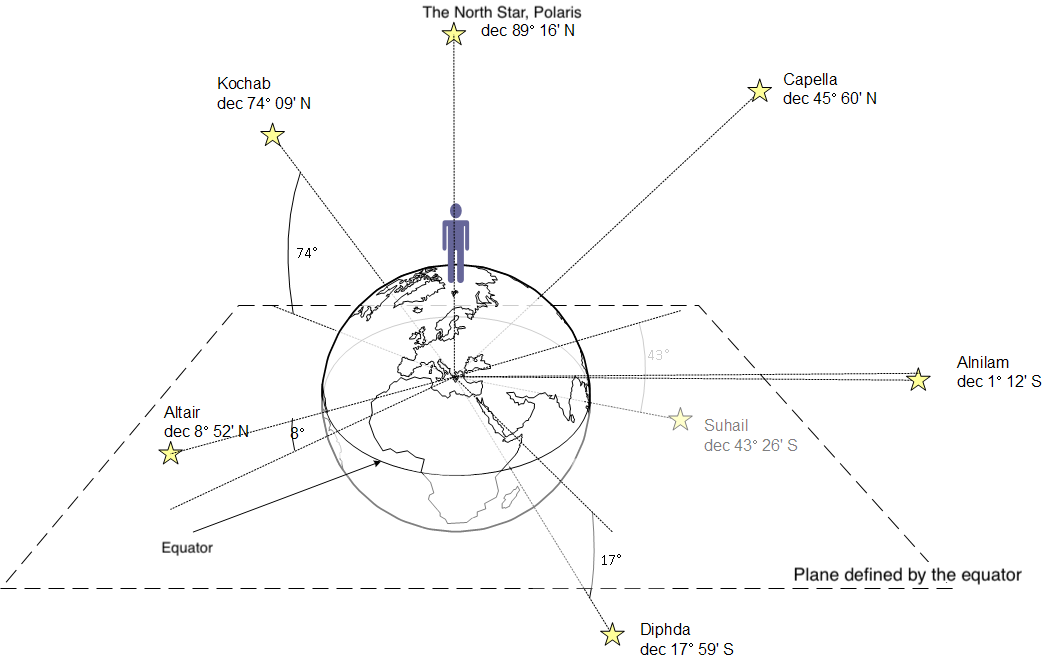
Northern declination means that the star is north of the plane defined by the celestial equator (N), and southern declination (S) means it is south of that plane. Alnilam is actually 1° south of the plane. This means that in principle it is below the horizon when you stand at the North Pole. However, due to atmospheric refraction, you can always see slightly below the horizon. That is why you should still be able to see Alnilam even from the North Pole. If you ever go there, send a text message and tell me if I’m wrong.
In the image above, Suhail and Diphda are examples of stars you would not see from the North Pole. Note also that the projection of these stars onto the Earth’s surface lies exactly at the same latitude as the star’s declination.
c o n t e n t s
- Determining position from stars
- Night sky
- Celestial sphere
- What you see at the North Pole when Earth rotates
- How the night sky changes when traveling to the equator
- Effect of Earth’s rotation on the sky at the equator
- Celestial meridian, upper and lower culmination
- Change in star altitude at the North Pole, equator, and in between
- Declination
- Example of determining latitude
- Hour angle, Greenwich Hour Angle (GHA)
- Aries, celestial Greenwich
- Sidereal Hour Angle (SHA)
- Local Hour Angle (LHA)
- Relation between hour angle and time
- Example of determining longitude and latitude from the Sun at noon
- Relation between angles, degrees, and nautical miles on Earth
- Celestial navigation circle
- Azimuth
- True bearing to a star
- Nautical triangle
- Solving the nautical triangle (altitude calculation)
- Position fixing using Marcq Saint-Hilaire intercept method
- Star identification
- Details and practice
- Time
- Time difference (ΔT)
- Altitude measurement
- Example of position fixing
- Twilight
- Calculating twilight time
- Navigation exam
Hamburg VII 2026