The Effect of Earth’s Rotation on the Starry Sky at the Equator
Let us assume that you now remain standing at the equator and let the Earth rotate normally. It begins rotating from west to east.
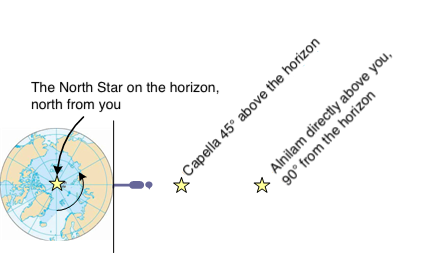
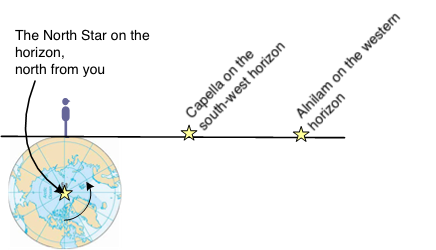
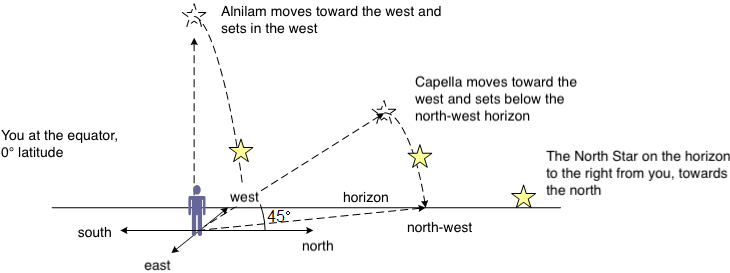
Turn to the right and point your nose directly toward the source. Polaris then remains on the horizon on your right side, but Capella and Alnilam appear to set in the west after 6 hours.
|
Initial situation |
6 hours later |
|
|
Another way to view the situation is closer to the Earth's surface. At the beginning, the situation is this.
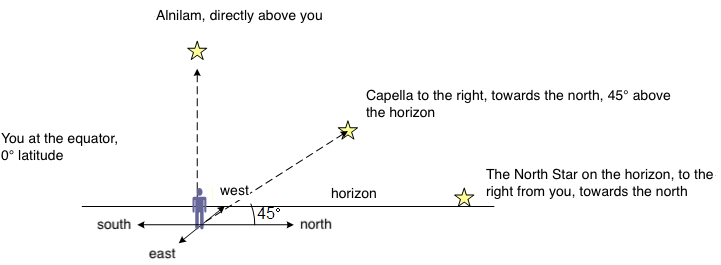
Seen looking from north toward south, the situation looks like this.
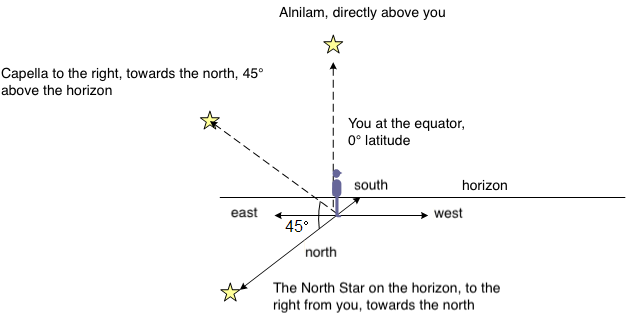
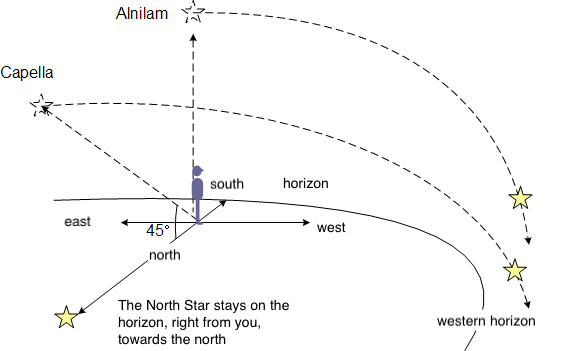
Within six hours, Alnilam and Capella descend from their upper culmination toward the horizon, reaching the horizon exactly six hours later.
Seen from the north, the situation looks like this. I have drawn the horizon as curved here so you can better imagine the real situation. Of course, the horizon appears all around you in every direction.
The stars that have set in the west remain hidden on the far side of the Earth for the next 12 hours. After that, they rise again in the east and, 24 hours after the start of the Earth's rotation, are once again at their upper culmination.
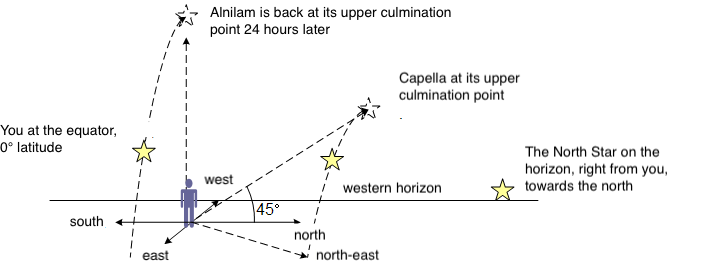
When a star is at its upper culmination, meaning at its highest altitude above the horizon, it is either directly south or directly north of you. Another way to say the same thing is that when a star is at upper culmination, its projection point on Earth is either directly south or north of you. If a star is at the zenith, its projection point is beneath your feet and the star is directly above your head.
If this is initially confusing, this may help. Take a globe in your hand and point its North Pole toward a ceiling lamp directly above you. The ceiling lamp corresponds to Polaris.
A table lamp or another object in the corner of the room at the same height as your globe (relative to the floor) corresponds to Alnilam. Place a small plush toy or toy soldier at the North Pole of the globe and imagine it walking from there to the equator. From which direction does the toy see Polaris first, and then the Alnilam equivalent? What if the toy Earth rotates around its axis?
C o n t e n t s
- Celestial Navigation
- The Starry Sky
- The Celestial Sphere
- What You See from the North Pole as the Earth Rotates
- How the Starry Sky Changes When You Travel to the Equator
- The Effect of Earth’s Rotation on the Starry Sky at the Equator
- The Celestial Meridian, Upper Culmination, and Lower Culmination
- Changes in Star Altitude at the North Pole, the Equator, and Between Them
- Declination
- Example of Determining Latitude
- Hour Angle, Greenwich Hour Angle (GHA)
- Aries, the Greenwich of the Celestial Sphere
- Sidereal Hour Angle (SHA)
- Local Hour Angle (LHA)
- The Relationship Between Hour Angle and Time
- Example of Determining Longitude and Latitude from the Sun at Noon
- The Relationship Between Angles, Degrees, and Nautical Miles on Earth’s Surface
- Circle of Equal Altitude
- Azimuth (A, Azimuth)
- True Bearing to a Star
- The Navigational Triangle
- Solving the Navigational Triangle, or Sight Reduction
- Celestial Navigation Using Marcq Saint Hilaire’s “Intercept” Method
- Star Identification
- Details and Practice
- Time
- Time Difference (ΔT)
- Altitude Measurement
- Example of Position Fixing
- Twilight
- Calculating Twilight Time
- Navigation Association Examination
Hamburg VII 2026